Floating timer · Mac, Windows, Linux
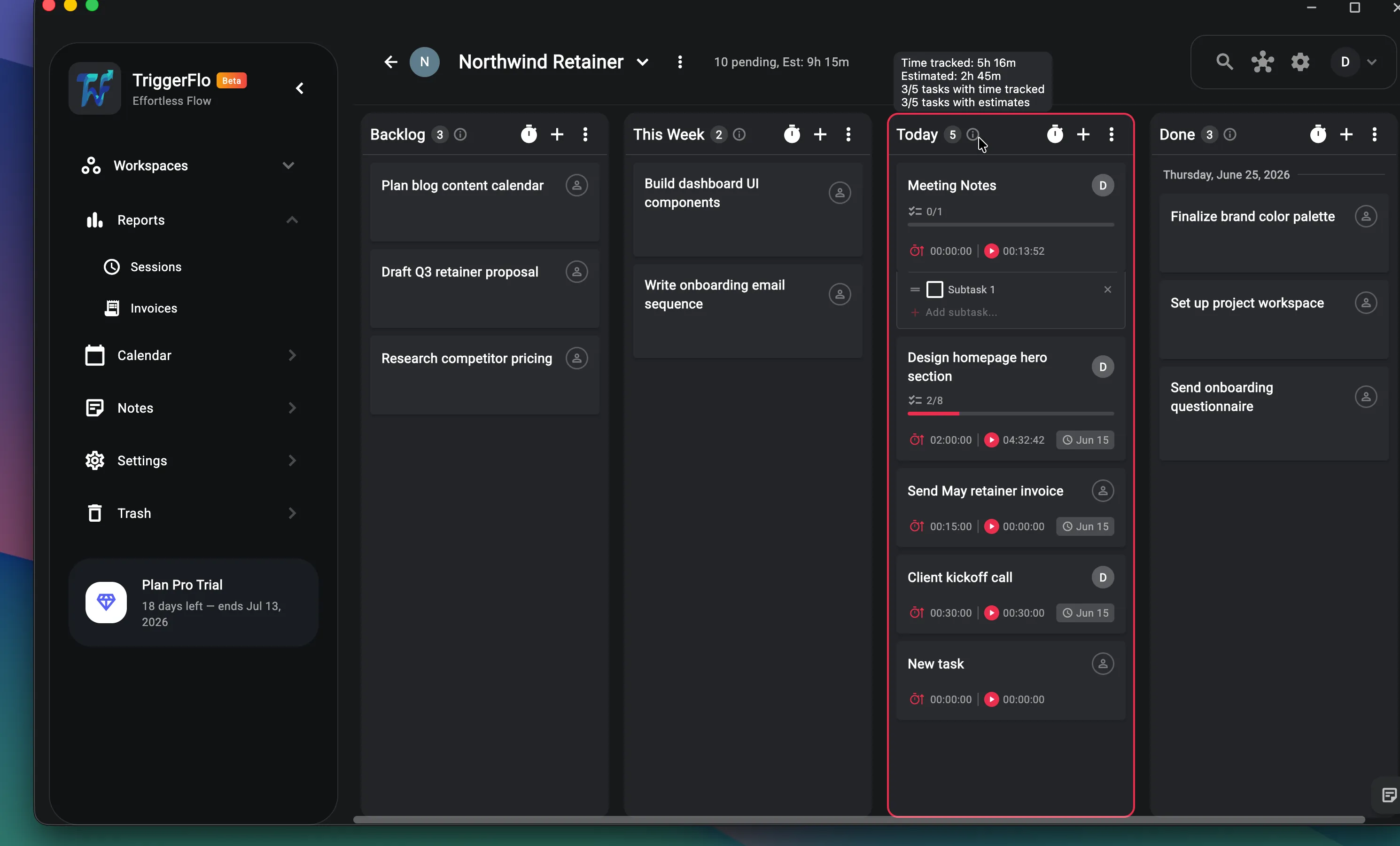
TriggerFlo is a Kanban board where every card has a timer, and starting one opens a floating window that stays above every other application. Four layouts — Small, Island, Compressed and Expanded. Mac, Windows and Linux, free up to 3 projects.
macOS 12+, Windows 10+, Linux. Pro $45.99/yr or $119 once.
TriggerFlo is a task manager with an always-on-top floating timer. Press play on a card and a timer window opens above every other application, showing the task you are on; switching tasks takes one click. It comes in four layouts — Small, Island, Compressed and Expanded — chosen under Settings > Timer, and it runs natively on macOS, Windows and Linux.
The reason to want this is narrow and specific: people stop tracking time because the tracker ends up behind three other windows. A timer you cannot see is a timer you forget to stop.
Tasks and time in one window
Search for a floating timer and you get two kinds of answer. Time trackers with a mini-timer mode, which count hours against a project but have no task board behind them. And standalone Pomodoro overlays, which are a countdown and nothing else. Either way the question "what was I actually doing for those 90 minutes?" is answered somewhere else, by you, later.
In TriggerFlo the floating timer is the front end of the board. It is counting against a specific card, so the estimate, the subtasks, the due date and the tracked total all live on the same object. Nothing to reconcile at the end of the week.
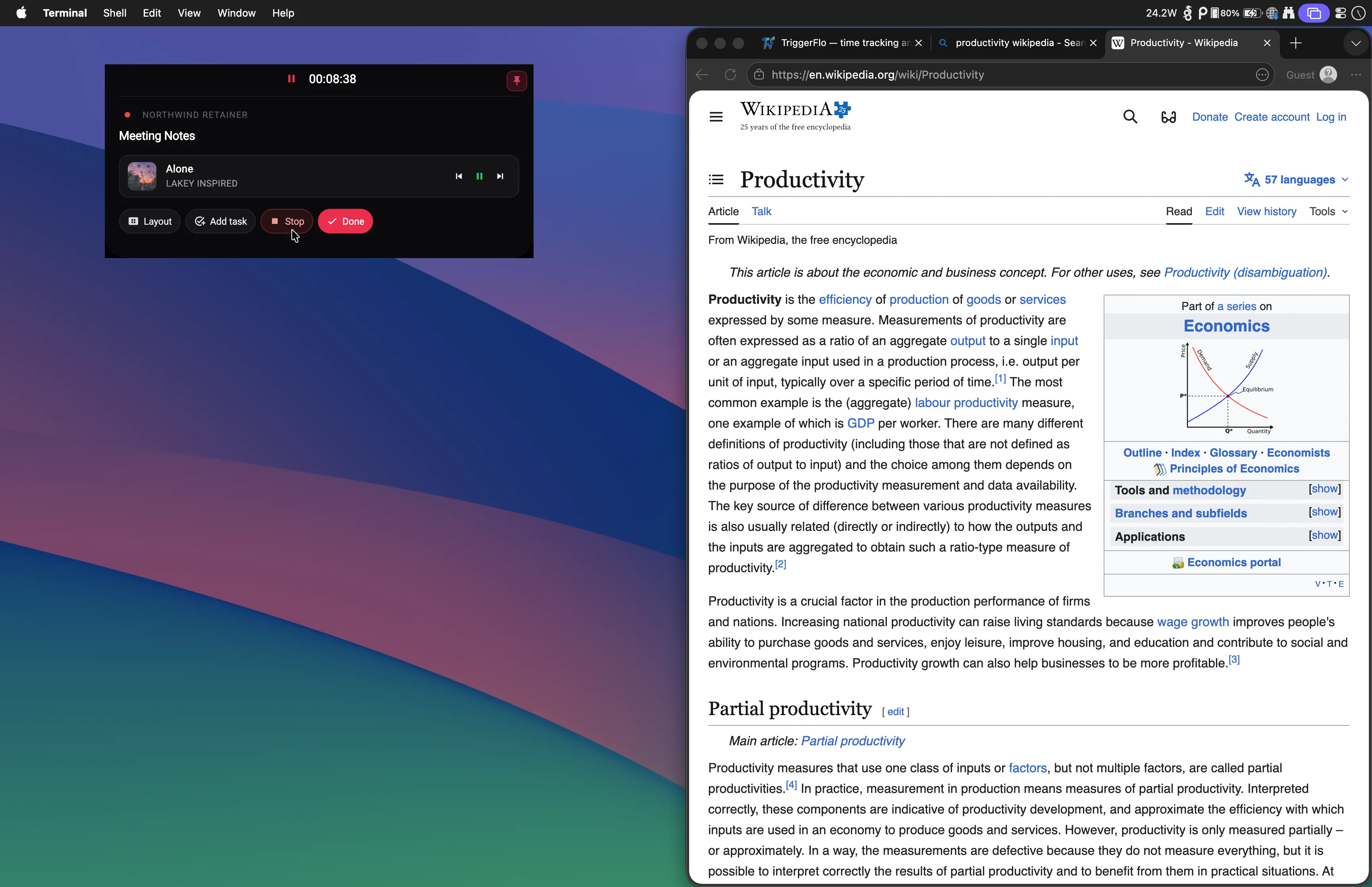
All four stay above other windows. They differ in how much of the screen they are willing to take. Switch under Settings > Timer.
Small
The default. A compact floating window that snaps to any of nine screen positions and remembers where you left it.
Island
A compact pill docked at the top of the screen, in the style of the Dynamic Island. Out of the way until you look up.
Compressed
A minimal bar with the essentials only — task name, elapsed time, stop. For a full screen with no room to give away.
Expanded
A full timer docked to the left or right edge, carrying the task description, subtasks and notes alongside the clock.
The timer also carries its own buttons — snooze to the next task, start a break, open notes and subtasks, mute the chime — and you can reorder or disable any of them under Settings > Timer. Corners can be rounded or square, and position memory reopens the window where you last put it.
"Always on top" is a window-manager feature, not a CSS trick, so it is worth being precise about where it does and does not hold.
macOS
A real always-on-top window, plus a menu-bar timer showing elapsed time while the main window is closed. macOS 12 or later, Apple Silicon and Intel.
TriggerFlo for macOS →Windows
Stays above Teams, your IDE and the browser. Closing the main window drops TriggerFlo to the system tray rather than quitting, so the timer survives. Windows 10 64-bit or later.
TriggerFlo for Windows →Linux
Works under X11 and XWayland, where GTK maps always-on-top to _NET_WM_STATE_ABOVE. Under native Wayland a window cannot raise itself, so the pill will not pin — launch with GDK_BACKEND=x11 to get it back.
TriggerFlo for Linux →On iOS and Android there is no always-on-top window — the platforms do not allow one — so the timer lives in a home-screen widget and a persistent notification instead, with companion apps on Apple Watch and Wear OS.
The board behind the timer
Kanban columns you define, subtasks, estimates against actuals, due dates, recurring tasks, tags, comments and attachments. Two-way Google Calendar sync. Time reports and invoicing when the tracked hours need to become a bill.
And nothing pointed at you: no screenshots, no activity scores, no idle detection reported to anybody. Why that is a deliberate choice →
Yes — TriggerFlo. It is a Kanban task board where pressing play on a card opens a floating timer window that stays above every other application. Most tools make you choose: a time tracker with an always-on-top mini timer but no real task board, or a task manager with a timer buried in a tab. TriggerFlo is both in one native app, free for up to 3 projects.
It is on by default. Click the play button on any task card and the floating timer window appears, already pinned above other windows. There is no setting to enable — the setting under Settings > Timer chooses which of the four layouts it uses.
Small is a compact floating window that snaps to a nine-position grid. Island is a pill docked at the top of the screen, in the style of the Dynamic Island. Compressed is a minimal bar with just the task, the elapsed time and a stop button. Expanded is a full sidebar docked left or right that also shows the task description, subtasks and notes. Switch between them under Settings > Timer.
Yes. On Windows 10 and 11 it is a genuine always-on-top window that stays above Teams, VS Code and the browser. Closing the main TriggerFlo window sends the app to the system tray instead of quitting, so the timer keeps running and you can start or stop from the tray menu.
Under X11 and XWayland, yes — GTK maps always-on-top to the EWMH _NET_WM_STATE_ABOVE hint and Mutter honours it. Under a native Wayland session it does not: the compositor owns window stacking and a regular application cannot raise itself, so the call silently does nothing. Launching with GDK_BACKEND=x11 puts the app on XWayland in the same GNOME session and the timer pins correctly.
Yes. The floating timer shows the task it is tracking, not just a number, and switching to a different task takes one click without opening the main window. A progress border fills or depletes as time passes, and in count-down mode it shows remaining rather than elapsed time.
TriggerFlo is free forever for up to 3 projects, with no credit card, and the floating timer is not a paid feature. Pro is $45.99 a year or $119 once for a lifetime license.
No. If all you want is a countdown pinned over your screen, a small Pomodoro utility will do it with less setup, and one of those is the better pick. TriggerFlo is for the case where the timer needs to know what you are working on — the floating window is the front end of a Kanban board that carries estimates, subtasks, due dates and reports.
Free up to 3 projects, no credit card. The floating timer is in the free tier.
New features and fixes as they ship on desktop and mobile. No spam, unsubscribe any time.